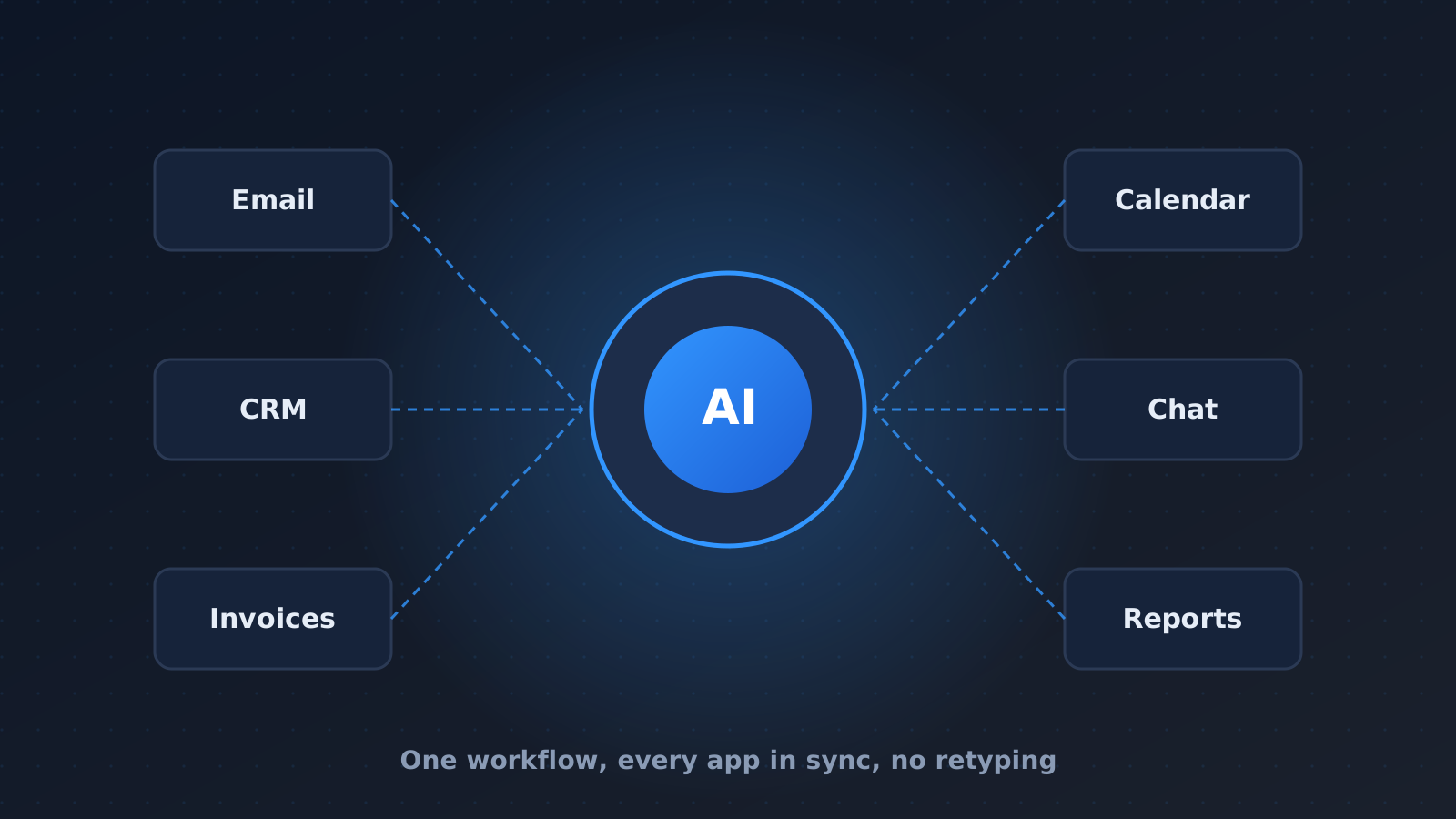
For most small businesses, growth eventually hits the same wall: the team is maxed out, hiring is expensive, and the processes that worked at 10 customers don't scale to 100. The answer used to be simple: hire more people. In 2026, a growing number of small and mid-sized businesses are finding a better answer first: automate the work that shouldn't require a person at all.
AI workflow automation isn't a future technology. It's running in small businesses today. It routes support tickets, qualifies leads, generates invoices, sends onboarding emails, summarizes meeting notes and flags inventory issues, all without anyone touching a keyboard. And unlike the enterprise automation of five years ago, today's tools are accessible to teams without a dedicated engineering department.
What AI Workflow Automation Actually Means
Traditional automation connected systems mechanically: if form is submitted, send email. Useful, but brittle. Any variation, such as an unusual input, a missing field or an edge case, breaks the flow or needs a person to step in.
AI-powered automation adds a layer of judgment. Instead of rigid if/then logic, workflows can now:
- Read and classify incoming emails, support tickets, or form submissions by intent and urgency
- Extract structured data from unstructured text, like order details from a customer email or action items from a meeting transcript
- Generate contextually appropriate responses, summaries, or documents using the extracted data
- Make routing decisions: send to human review when confidence is low, process automatically when it is high
- Learn from corrections over time, improving classification accuracy without retraining from scratch
The result is automation that copes with real-world messiness as well as clean, predictable inputs.
Where Small Businesses Are Seeing the Biggest Returns
Customer support triage. Take a small e-commerce team that reads and sorts every support email by hand. An n8n workflow can classify each incoming message (order status, return request, product question, complaint) and route it to the right queue with a draft reply for the agent to review and send. The agents stop sorting and spend their time answering, so customers hear back much faster.
Lead qualification and follow-up. Sales teams at small B2B companies often lose good leads because follow-up was inconsistent. An AI workflow can score inbound leads based on company size, industry, and engagement signals, then automatically enroll them in a personalized email sequence, schedule a calendar link, and notify the sales rep, all within minutes of the form submission. No leads fall through the cracks while the rep is in a meeting.
Invoice and contract processing. Professional services firms spend significant time on administrative work that doesn't require professional judgment. Parsing a vendor invoice, extracting line items, matching against a purchase order, and routing for approval is a perfect automation target. AI document processing tools handle handwritten notes, varied formats, and missing fields that rule-based systems cannot.
Internal knowledge and onboarding. Every time a new employee asks "where do I find X?" or "what's the process for Y?", someone senior has to stop what they're doing. An AI assistant trained on internal documentation, past Slack conversations, and SOPs can answer these questions instantly, and flag when documentation is missing or outdated.
The Tools Making This Accessible
For small businesses, the field has settled on a handful of capable tools:
n8n (self-hosted): open-source workflow automation with native AI agent nodes, LLM integrations, and 400+ service connectors. No per-task fees when self-hosted via Docker. Ideal for teams that want full control over data and no usage-based pricing surprises. We use n8n for our own workflows and recommend it to businesses that handle sensitive customer data.
Make (formerly Integromat): visual workflow builder with strong HTTP/API support and a more gentle learning curve than n8n. Usage-based pricing makes it cost-effective for lower-volume automations.
Zapier with AI steps: easiest entry point, widest app library. Best for simple automations. Cost climbs quickly for high-volume or complex flows.
Custom LLM integrations via API: for businesses with specific AI processing needs, direct integration with Claude, GPT-4o, or Gemini APIs gives the most flexibility. The tradeoff is more development effort upfront.
The right tool depends on your data sensitivity, volume, budget, and whether you have someone technical enough to maintain a self-hosted instance. For most small businesses starting out, Make or Zapier is the fastest path to working automation. n8n is the right long-term choice for teams that want to scale without per-task costs.
A Framework for Identifying What to Automate First
Not every process is worth automating. The best candidates share three properties: they happen frequently, they follow a consistent enough pattern that a human applies judgment in a predictable way, and the cost of getting them wrong is recoverable (or easily caught in a review step).
A simple scoring method: for each repetitive process, rate it on three dimensions from 1-5:
- Frequency: how often does this happen per week?
- Time cost: how many minutes does it take per occurrence?
- Judgment required: how much human reasoning does it actually need? (lower = better automation candidate)
Multiply frequency × time cost ÷ judgment required. The highest scores are your first targets. A process that happens 50 times per week, takes 10 minutes, and requires minimal judgment scores far higher than one that happens twice a month, takes an hour, and involves complex decision-making.
What Automation Can't Replace
This matters: AI workflow automation is most effective when it handles the mechanical parts of work, freeing people for the judgment-intensive parts. It doesn't replace relationship-building, creative problem solving, or the trust that comes from human interaction with customers in complex situations.
The best implementations treat automation as a way to make people more effective. The support agent who used to spend hours a day sorting tickets now spends that time on the complex, emotional cases where a person really makes the difference. The sales rep who used to forget to follow up now gets in front of every warm lead within hours. The operator who used to spend Friday afternoons doing expense reconciliation now has those hours back for work that grows the business.
Getting Started
The most common mistake is trying to automate too much at once. Start with a single high-frequency, low-judgment process. Build it, run it alongside your manual process for two weeks to validate accuracy, then hand it off fully. That first successful automation builds confidence and reveals the next obvious target.
For most small businesses, the right starting points are either customer communications (triage, routing, follow-up) or internal data processing (invoices, reports, notifications). Both are well-supported by today's tools, have clear ROI, and don't require deep technical expertise to implement.
The competitive advantage of AI automation isn't available only to companies with 500-person engineering teams anymore. A 5-person business that automates well can answer as fast and as consistently as a much bigger team, and that advantage grows over time.